According to the National Retail Federation, Halloween is usually a $8 billion holiday, reported as our second highest holiday in spending, after Christmas.
Retailers will feature Halloween products this year, targeted to all age groups. They have already ordered their wares this past summer, hoping or begging, for sure, that their Halloween cash register rings.
What will sell? In the past we’ve had Halloween greeting cards, screensavers, joke items, costumes, movies, games, as well as Halloween safety supplies. But it’s hard to celebrate with masks.
Or harve you already prepared your costume, with one of your masks? The 2 Guyz found plenty of costumes celebrating Mulan, Space Force, Frozen II, Black Widow, Minions, Marshmello, and Baby Gizmo.
One thing we’ve talked about in Marketing and advertising classes is the fact that Halloween is now an adult reason to party. Do a Google search for costumes and you may discover more references for adults than for the little guys and girls.
Last year, adults were also looking beyond basic gear; the search term “sexy Halloween costume” has surged over the past several years.
The words “Trick or Treat” didn’t appear in the files of “Merriam-Webster” until the early forties and the practice coincided with population shifts from rural to urban and suburban developments.
This year may not be Halloween without its cartoon characters, monsters and ghosts that will frighten moms. No, it may be the fear of Covid-19 or of disappointing their little monsters. ]]>
Find this under our long-lasting “Promotion” file.
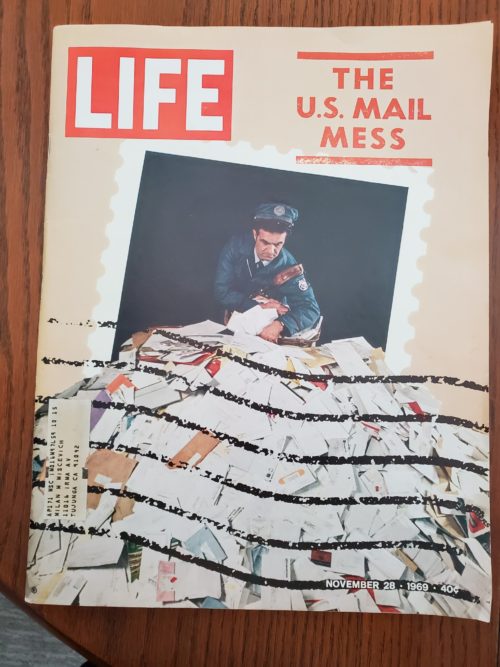
Last weekend a creative director friend gave 2 Guyz Londre a November 28, 1969 copy of LIFE magazine.
On page 13 was an Arrow Cordial’s ad with the flavors of “finest mint,” “rich, rip blackberries” and “finish cocoa.”
Londre can report that this “breathtaking” offer is still working.
They were using the subhead: “Up until now (or in November 1969) the only way you could smell the real fresh aroma of the fruits, herbs and spices that go into every Arrow Cordial, was to open a bottle. Now all you have to do is scratch.”
Londre did some Internet research today and found “Created in the early-twentieth century using secret family recipes from Europe, Arrow® is the #3 best-selling cordial line in America. The product line includes a full array of flavored schnapps, sweet and sour Smackers and brandies, vodka, rum, as well as traditional cordials, liqueurs and creams.
For many advertising campaigns, The 2 Guyz would say that the type of product you are selling is one factor in how long an advertising ad or campaign takes to work.
Some will say in a week or a month.
Give any campaign at least two to four weeks to see if it’s going to work or not.
One more discovery: The Creme de Menthe or Arrow Creme De Menthe White 30 Proof 750ml 12-In is now Peppermint.
]]>“I don’t buy it”, said Londre one of The 2 Guyz.
The networks can find or commission research to say anything they want.
The 2 Guyz know and teach that there are different audiences watching, Fox, MSNBC and CNN. Under “People,” in the 9P’s of Marketing, we teach that you can break down an audience into several characteristics, including demographically, geographically, behaviorally, psychographically, and with technographics.
Psychographics is the science of dividing into groups on psychological /personality traits, lifestyle, or values. People in the same demographic groups may be very different in their psychological profiles.
For different products and services, advertisers have always bought environment or the environment of the show. It’s one of the aspects of media planning and buying.
Londre doesn’t buy it that: “Viewers without fail say they don’t penalize a brand for sponsoring something that the company may not stand for,” as the president of NBCUniversal ad sales recently said.
Not surprisingly, the sample size was only 18 for their hour-long interviews. Really, 18 respondents? (We also sometimes teach marketing research, and 18 is hardly projectable for a viewing population of over 100,000,000.
Viewers “…understand the distinction between editorial and advertising,” according the evp of ad sales for Fox News. He went on to say that “…viewers appreciate the commercials they know help put Bret Baier and Chris Wallace on their TV screens.” Really? Do they?
In this hyper-charged political environment, is it that easy to divorce oneself from feelings when news programs, on both sides, are slinging mud and questionable news stories, certainly ones with definitive political points of view?
This sounds much more like a PR campaign to sell more advertising in their shows.
How do networks make money? It’s by selling TV spots. They care about eyeballs. No more, no less.
]]>The 2 Guyz will be putting out their worst ads and marketing for 2019 soon. We call them the “Baddies.”
At the top of the list may be all political ads.
But first a thought or two on all ads, and then on political ones for candidates and ballot issues.
P&G reported $7.1 billion of advertising spending, last fiscal year. Their chief brand officer at Procter & Gamble, one of the largest advertisers in the world said that ads are often irrelevant and sometimes “just silly, ridiculous or stupid.”
It was also reported that P&G added that “… 70% of people say they don’t like advertising.”
There was a time when more people believed in the media.
The 2 Guyz teach Marketing and advertising. We teach that brands cannot make false claims, but politicians and propositions can make false, ridiculous claims.
The FTC (Federal Trade Commission) is in place to protect consumers from false or misleading advertising from brands, making deceptive claims and ads illegal.
But under our 1st Amendment, politicians can run whatever they want, in the media and specifically on the networks, social media, Facebook and YouTube.
The First Amendment reads, “Congress shall make no law respecting an establishment of religion, or prohibiting the free exercise thereof; or abridging the freedom of speech, or of the press; or the right of the people peaceably to assemble, and to petition the Government for a redress of grievances.”
And as a nation we are protected from false advertising claims unless they ae political. ones.
The question is how many hate political ads? It has to be higher than 70%. Maybe 90+%. The sad point is we will have a ton of ads, which are silly and ridiculous between now and next November.
Most of us hate election cycles and all the lies, misleading messages, and lack of ethical standards. Unless you are selling advertising space and time for a living, then this is the bull market for you.
It’s the media that likes advertising spending. More ads means more revenue. Damn the torpedoes, full speed ahead!
]]>And then it pops up. Or, “poops” up, if you will.
Air Wick’s new VIP (Very Important Pooper) spray rears its, well, less than attractive head.
Think back a year or two, and PooPourri.com went viral with their sweet British accented-spokeswoman chatting cleverishly about the indiscretions of bathroom smells. The spot walks right to the edge of propriety, but somehow straddles it just enough to keep it fun, and not gross.
Unfortunately Air Wick crosses the line. It could have straddled the line, but they chose not. The creatives on this thought a full frame shot of a older man, an airline pilot, sitting on the loo, with shorts around his ankle.
The 2 Guyz like funny spots as much as anyone. Heck, we’ve written and created advertising that gets close, and yes, sometimes crosses the line, but feel it’s only worth it if you’re in a competitive position to capitalize upon it. This is usually reserved for a small, unknown brand that needs to create a name for itself, and shock value matters.
Think GoDaddy.
We’re not puritans here. Far from it. But we do like guiding our clients down paths of long prosperity.
Not sure this spot fits the bill.
Product. Price. Place. Promotion, developed in 1964. Over 50 years ago.
This is a “foundational” concept. The four areas of decision making we all as marketers face.
And for the better part of 50 years, Jerome McCarthy’s 4 P’s have guided students and professionals alike.
The question arose,recently, when The 2 Guyz On Marketing were discussing its relevance in today’s marketing world. And while the 4P’s are still valid, still relevant, they are lacking.
We know, that’s sacrilege for a marketing professor to say. But we believe it’s true. Product,price, place and promotion are all still important…but they’re not enough!
Eleven years ago, Larry,one of The 2 Guyz, created (and owns a copyright for) the the Nine P’s/9 P’s of Marketing ©2007. This starts where the 4 P’s leaves off. in the study and practices of Marketing.
Developed over many years of teaching undergraduate and graduate Marketing, advertising, global studies at USC, CSUN, Pepperdine, LMU, plus decades of consulting, the 9 P’s of Marketing add new layers, important layers, to understanding the key building blocks of marketing.
The 2 Guyz On Marketing use both the 4 P’s of the Marketing Mix and Larry Steven Londre’s Nine P’s of Marketing, which add five (5) more P’s.
The 9P’s of Marketing are:
- Planning (Research)
- People (including segmentation and targeting)
- Product (and Services)
- Price
- Promotion (which has eight different components)
- Place (or distribution)
- Partners (or alliances)
- Presentation
- Passion
Larry tells the story of how he began to transform the 4 P’s. “In the late 60’s I was first taught in marketing at USC that the ‘customer,’ or potential purchasers, buyers were kings, but they were missing as one of the 4P’s. I always felt it is one of the most important of the P’s – “People.” “People” have to be there for potential and actual purchases. They are one of, if not THE most important components of Marketing decision making.”
The other 2 Guyz, Brian,adds more to Larry’s 9 P’s. “I challenged Larry when he first developed his 9 P’s. I thought it was a gimmick, but the more I test it, the more I see he’s right. For example, with our Planning, or research, marketing is destined to fail It allows takes into account research and development, critical to keeping marketing of any product or service relevant.
Partners or alliances are another are that modern marketing can’t overlook. Channel dynamics alone justify its presence. In the previous century there were catalogs, like the once formidable Sears Roebuck & Company, and there was retail. That was pretty much it. Sure, there was B2B that’s the whole thing. Now we have wholesaling, Amazon, reselling,affiliate channels, direct to consumer, distributors, online/offline distribution, etc.
As we turn from the past, and look toward the future, The 2 Guyz On Marketing will be showing and highlighting ways the 9P’s better explain the marketing mix, but in fact becomes a working model for use in day to day marketing operations.
Going into 2019, the 9P’scan help you and your company in endless ways looking at you potential customers and the marketplace which is constantly changing along with competition.
For more on insights,ideas, concepts and Marketing solutions, visit londremarketing.com and look under “Articles and Resources” and the 9P’s/Nine P’s ©2007. Specifically you will find them detailed at 9P’s/Nine P’s or nineps.com.
]]>One of the reasons given by Sea World’s CEO for the recent increase in attendance and revenue? Beer sampling. Sea World brought back “free beer” in summer promotions.
Let’s go back forty plus years. After college at USC, Larry remembers going to Busch Gardens in the San Fernando Valley. Brian was a bit younger, but remembers trips to the brewery.
Bus Gardens was a cheap date. The admission was under $2, each.
Busch Gardens featured a beer making tour, live performances, a monorail, boat rides, bumper cars, lagoons, waterfalls, plus free beer.
You couldn’t consume “all of the beer” offered. Visitors of drinking age could be offered two 10 oz. glasses of beer at each of the five pavilions. Unbelievable, but those were the times. Larry remember just watching the patrons. We would now call it “Marketing” research. Brian remembers walking around with dad “sampling” from the Michelob Garden, or the Busch Garden.
It would never happen, now.
Thank God and Mothers (and others) Against Drinking and Driving.
So basically, tt was rides, entertainment and almost free beer.
One more point: I started teaching business classes in 1975 and remember teaching that Anheuser Busch and Busch Gardens had “free beer” for its brewery’s employees. Could you see that now?
After an employee accident involving a pedestrian the free beer for employees ended in early May, 1986. But wait, there’s more.
The beer employee union negotiated for each employee, two free cases a month. Brian remembers going to a friends birthday and having a “very special” Bock beer from the brewery in the 1990s. Turns our his friend had an uncle who still worked at the brewery, and donated his two cases to the party.
How times have changed, but ‘free” beer is still around for potential customers and to help build revenue.
Want to learn more? Read Dan Ariely’s Predictably Irrational: The Hidden Forces That Shape Our Decisions. A whole chapter on free beer.
]]>
A recent feature in AdAge brought up the growing practice of Chinese advertising agencies charging to pitch clients.
We like it.
On average, based on our collective experience working within multiple advertising agencies for decades, you knew that your agency had two to four internal teams working on new business presentations, sometimes for several different client pitches. That’s a lot of man hours not going to put cookies in cupboard. If you didn’t have the manpower there were “expensive, but fast” freelancers brought in to create and assist.
Most of the time new business was taking time and resources away from existing clients and adding more working hours in the day, week, month. There was always a pitch or pitches that were tapping production departments to create spec, print, videos and other digital.
So instead of offering spec, free creative presentations, they should turn into “paid” client presentations. Sounds easy. Not always in practice. Why? Because in big markets, and in many small markets, too, there is always a smaller firm looking for their big break, willing to do whatever it takes to land an account.
The Bad Part of Pitches:
- Emotionally it’s draining, for all sides –clients and agencies.
- Who do you feel is paying for all of these spec pitches? Yes, existing clients.
- It’s an expensive, frustrating and time consuming practice.
- To me, it’s clear that this process isn’t working since there are too many RFPs. I remember back reading in AdAge and Adweek about the US Postal Service sending our 220 proposals.
- There are legal issues on using the work that is presented, used and not paid for.
- It’s a distraction for all in the agency plus for existing clients.
- There’s a good chance your odds of winning the pitch are low or lower, no matter how much you feel and think your odds are good.
- Working for free is dumb.
- Working for free isn’t smart for your existing clients.
The Good of Saying “No.”:
- There are just too many RPFs sent by inexperienced clients, and this practice goes all the way back to the MadMen era.
- If more agencies said “No;” more agencies will get paid for spec work. Let’s educate the clients.
- By saying “No,” it makes your agency more important, desirable and credible.
- You won’t see your ideas or parts of your creative used without compensation or a thank you.
- You will get paid for work.
- As an agency, your overall costs will go down especially if you hire freelancers for spec creative presentations.
- Saying “No” to spec pitches feels good.
One agency usually has the inside track based on a variety of reasons, not the least of which is usually an existing relationship with the client.
The 2 Guyz feel nothing is going to change unless more agencies come together, like the Chinese agencies. Agencies to “Just say no.”
Few professions work on spec. Those that do run the risk or no payment or sending client to collection. And they often charge exorbitantly higher rates.
We once heard an agency exec say, “We’re not in the banking and loan business, we’re in the ad business.”
We all need to join forces to end the misguided venture of spec work. Clients and agencies alike; it’s time we all said “No” to spec.
Too bad Don Draper, McCann and Grey didn’t put a stop to these spec pitches long ago.
]]>